First Flag CTF: The Write-Up, the Scoreboard, and How Every Challenge Fell
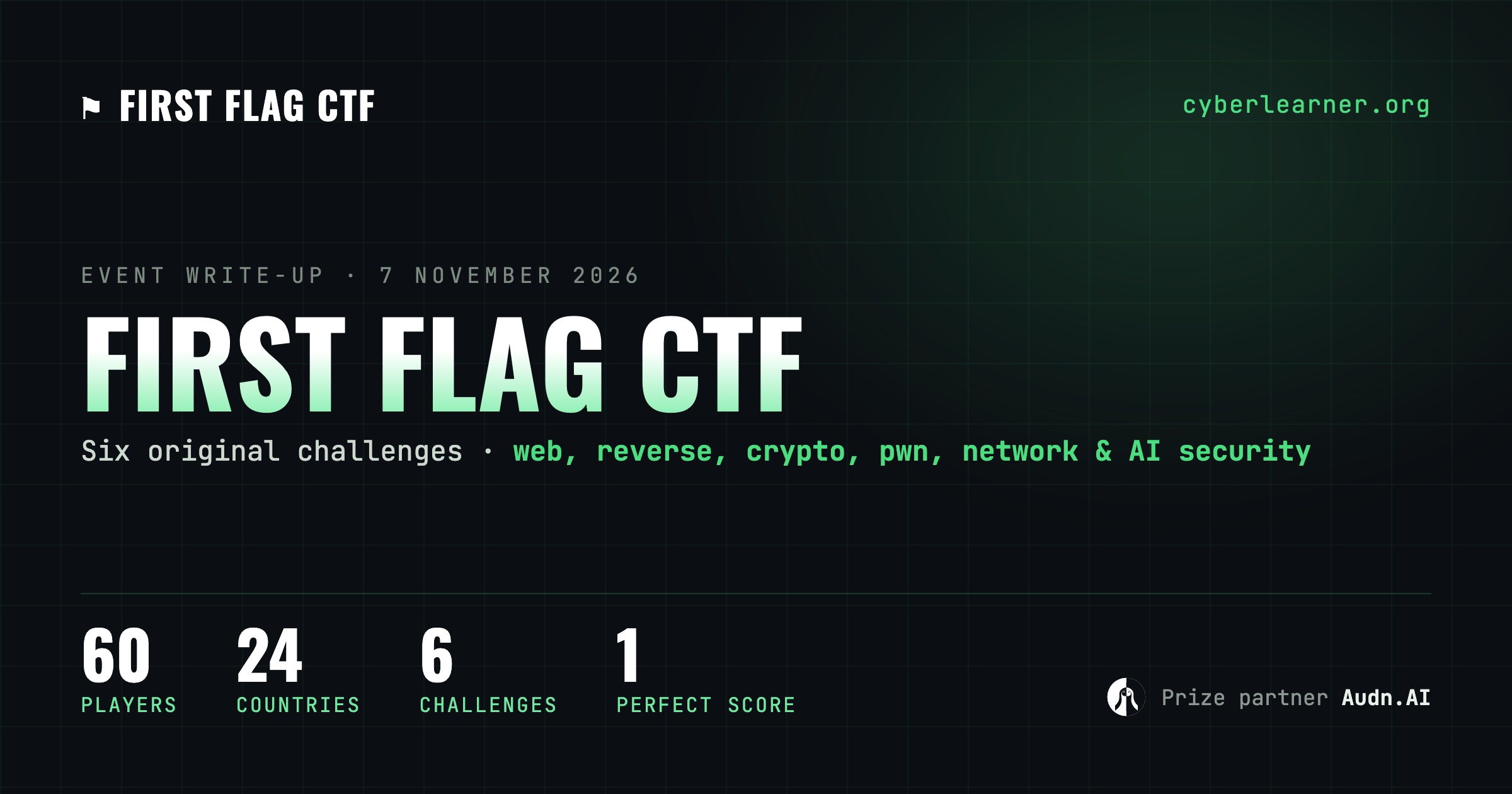
On 7 November 2026, CyberLearner ran its first live capture-the-flag. For six hours, 60 players from 24 countries went after six original challenges, built from scratch for the event and spread deliberately across the whole discipline: web, reverse engineering, cryptography, binary exploitation, network, and AI security. Entry was free. One player cleared every single one.
This is the full write-up. The final scoreboard, what each challenge actually tested, and, for every one, the single idea that turned a locked door into an open one. The six labs are live and public now, so if you want to try before you read the spoilers, the links are in the table below.
What this covers
- The event by the numbers: who played, who scored, and where the points went.
- The final scoreboard, top to bottom, archived here and on the live board.
- The six challenges: category, points, how many cracked each, and a short walkthrough of the intended path.
- Prizes and certificates, including the ones anyone who caught a single flag can still claim.
The event by the numbers
Six challenges, worth 1,450 points in total, scored on each challenge's own value rather than on how many people had solved it. The spread of solves is the interesting part. The hardest lab by solve count wasn't the one worth the most points, and the one most people cracked was a binary-exploitation challenge, which is not how CTFs usually go.
- 60 players took part, from 24 countries across the six-hour window.
- 10 players put at least one flag on the board.
- 1 player, LunaX, solved all six for a perfect 1,450.
- The least-solved challenge was A Good Signature (a crypto length-extension forgery) with a single solve; the most-solved was Session Service (a heap exploit) with ten.
The final scoreboard
Ranking follows the usual CTF convention: points first, and where points tie, the player who reached them earlier is placed higher. The full, live board is archived at cyberlearner.org/ctf-scoreboard.
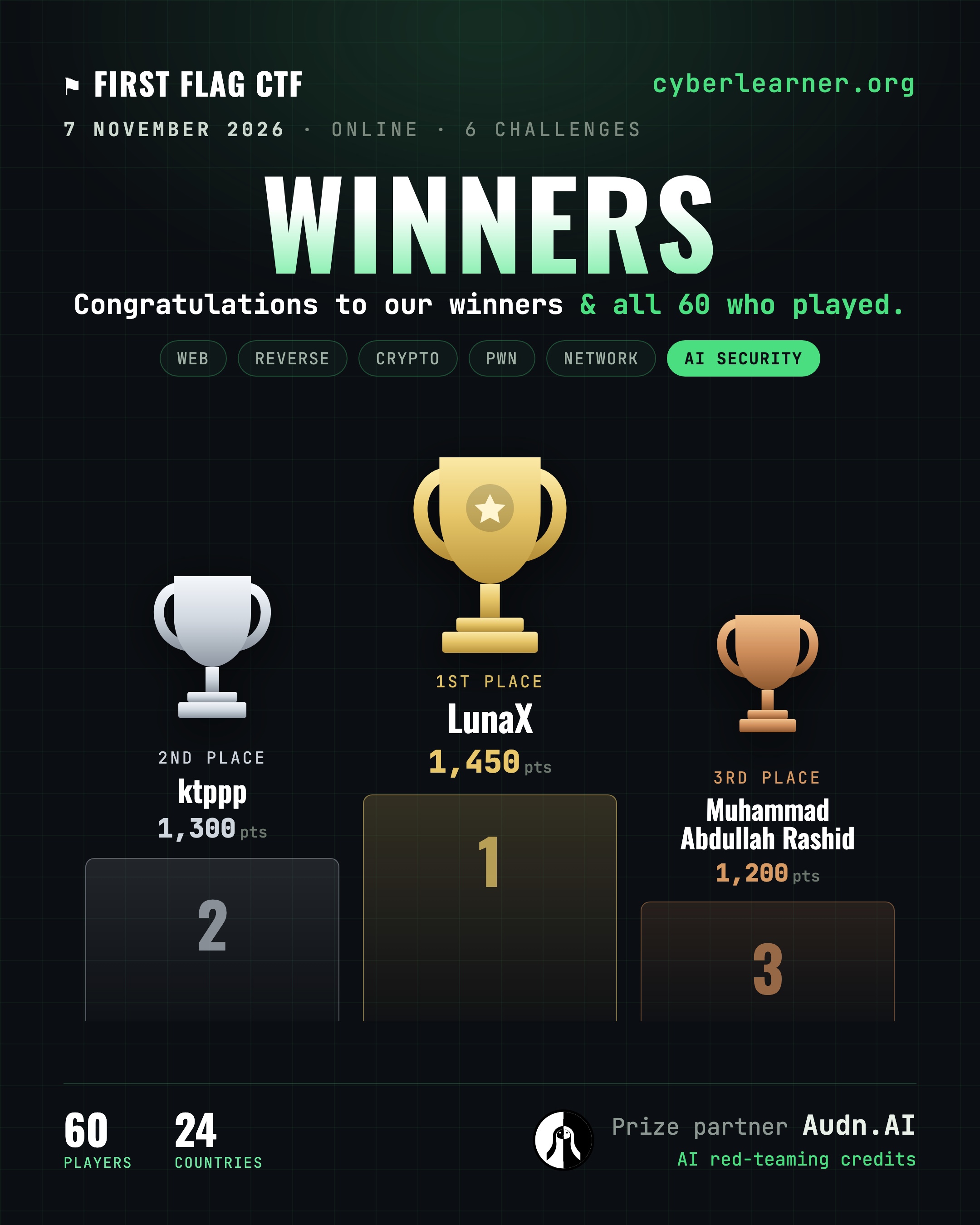
| # | Player | Points | Solves |
|---|---|---|---|
| 🥇 1 | LunaX | 1,450 | 6 |
| 🥈 2 | ktppp | 1,300 | 5 |
| 🥉 3 | Muhammad Abdullah Rashid | 1,200 | 4 |
| 4 | The_ROOK | 1,000 | 3 |
| 5 | Paulos Berihun | 750 | 2 |
| 6 | R0z4r1y0 | 600 | 2 |
| 7 | BombaWilliam | 600 | 2 |
| 8 | ROHAN KOKATARE | 450 | 2 |
| 9 | Bravin Kimutai | 350 | 1 |
| 10 | Akhilesh M | 350 | 1 |
The six challenges
Each challenge shipped under a deliberately plain name and a one-line prompt, with no category label, so part of the work was recognising what kind of problem you were looking at. Here they are in points order, each linked to the live lab.
| Challenge | Category | Points | Solves |
|---|---|---|---|
| A Dashboard | Web | 100 | 3 |
| A Good Signature | Web · Crypto | 150 | 1 |
| Vault Terminator | Web · Reverse | 200 | 3 |
| Find the Stream | AI Security | 250 | 6 |
| Session Service | Pwn | 350 | 10 |
| Paper King | Network | 400 | 5 |
Spoilers from here. Everything below walks the intended solution. If you would rather solve them cold, the links above open the live labs first.
A Dashboard · Web · 100
"Register an account and explore the dashboard." The sign-up accepts a field it should never trust: the account's role travels in the request body, so you grant yourself privileges the form never offered. From there the money-transfer feature never checks the sign of the amount. Send a negative transfer and the balance moves the wrong way, past the threshold an automatic verification step was guarding. The session token is then minted from that escalated row, and the flag is yours. The lesson is the oldest one in web security, written twice: never build an object straight from user input (mass assignment), and never trust a client-supplied number to be positive.
A Good Signature · Web and Crypto · 150
"Practice your signature." This was the hardest of the day: one solve. robots.txt quietly points at a path it was trying to hide, and that endpoint verifies requests by hashing secret || message with a bare SHA-256 and comparing the digest. That is the exact shape of a length-extension attack. Because SHA-256 leaks its full internal state in the output, you can take a message you already hold a valid signature for, append your own instruction, and compute a correct signature for the longer message, all without ever learning the secret. Forge the extended request, and the server signs off on something it never meant to.
Vault Terminator · Web and Reverse · 200
"Reverse the terminator." The unlock logic ships as compiled Python, a .pyc file with no source. Decompile it and you find a rolling-key decode: the key is never written down in plaintext anywhere, so you have to reconstruct it step by step from the routine itself. That gets you most of the way, but not all of it, the second ingredient the check wants is hidden behind another robots.txt breadcrumb. Reverse the one, recover the other, and the vault opens.
Find the Stream · AI Security · 250
"Follow the stream!" A business-logic slip on the web front end leaks a way to reach an internal AI "clerk", an agent wired with more authority than its job needs. This is OWASP LLM08, Excessive Agency: the model can take actions well beyond what the user should be able to ask for. Coax it past its remit and it does the work for you, leaving the evidence in a captured network stream. Pull the flag out of that pcap, and you have chained a web bug, an over-trusted AI agent, and a forensics step into one solve. Six players found the whole chain, the second-most of the day.
Session Service · Pwn · 350
"Find a live leak." The most-solved challenge, which surprised us for a binary exploit. It is a live network service with a heap use-after-free: an object is freed but still used, and you can reclaim that slot with data you control. Each connection hands you a leak that defeats ASLR on the spot, so you forge against live addresses rather than guessing. Reclaim the freed object, overwrite the function pointer it holds, and redirect execution. The prompt is the whole strategy: the leak is per-connection, so you read, then forge, then fire, every time.
Paper King · Network · 400
"Good luck printing." The top-value challenge, and the only one that is a small network rather than a single box. Scan it and you find an office printer that gives up far too much. Two roads in: read its memory over PJL, or factory-reset it over SNMP; either way you recover the scan-to-email credentials it had stored. Those credentials then pivot you into an internal portal that holds the flag. The printer as a soft entry point into a corporate network is not a contrivance, it is one of the most reliable footholds there is.
Prizes and certificates
The top three won AI red-teaming credits from our prize partner Audn.AI, an AI security company: £100 / £50 / £25. Every placement comes with a certificate, and this is the part worth repeating: anyone who submitted at least one correct flag can claim a certificate too. Like every CyberLearner credential, these are signed twice, once with Ed25519 and once with ML-DSA-65, the post-quantum standard NIST published as FIPS 204, and anyone can check one at cyberlearner.org/verify. More on how that works in our certificates guide.
Thank you to everyone who turned up, stayed up, and kept submitting. Building the challenges was the easy half; watching 60 people from 24 countries take them apart in real time was the reason to do it. We will run the next one soon, bigger, same principle: free to enter, built from scratch, open to everyone.
CyberLearner.org is a free cybersecurity training platform, built on the curriculum of the International Cybersecurity Olympiad (ICO). Every lab is hands-on and runs in your browser. It is open to everyone, regardless of skill level.